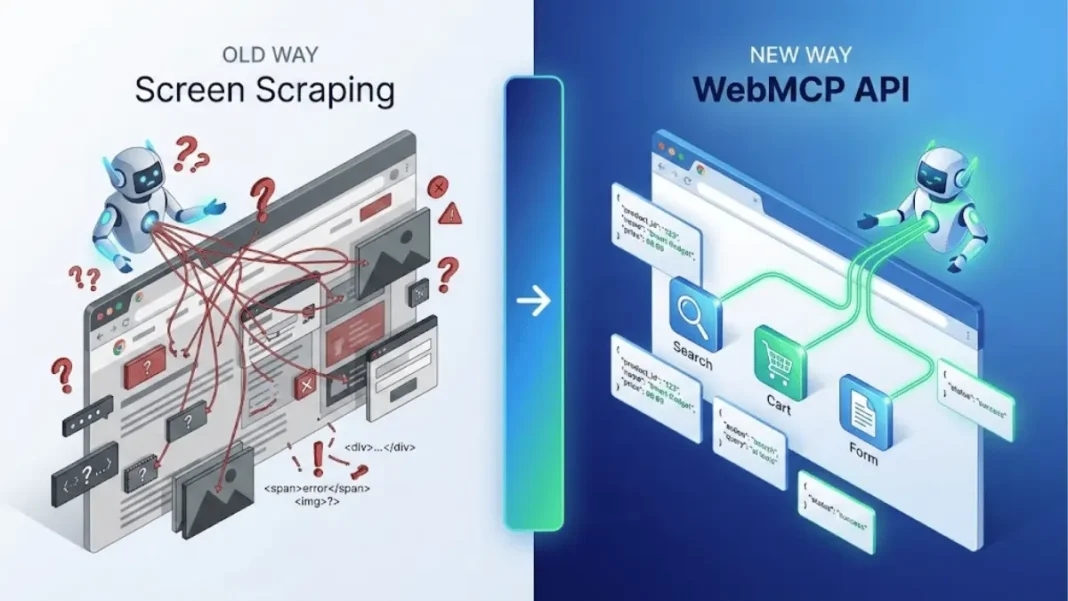
For the last few years, AI agents have been “blind” users. When you ask an agent to book a flight or buy a tool, it has to scan your website’s pixels, guess what a “Submit” button does, and hope your CSS doesn’t change mid-task.
On February 11, 2026, Google officially ended that era by previewing WebMCP (Web Model Context Protocol).
At Noble IT Services, we are closely tracking this protocol because it represents a “Mobile-First” level of shift for local businesses in Anna, Frisco, and beyond. Here is the breakdown of why WebMCP is the new handshake of the internet.
The Problem: The “Pixel-Reading” Bottleneck
Currently, AI agents use “Computer Use” or “Screen Scraping” to navigate. This is slow, prone to errors (hallucinations), and incredibly brittle. If a developer changes a class name from .btn-submit to .btn-confirm, the AI agent gets lost.
The Solution: WebMCP (The Model Context Protocol for the Web)
WebMCP is a new standard that allows a website to tell the browser exactly what its tools are. Instead of the AI guessing, the website publishes a contract.
It works via a new browser API: navigator.modelContext.
The Two Ways to Become “Agent-Ready”
Google has introduced two ways for developers to implement this:
- The Declarative API (Simple): You can annotate your existing HTML forms with a
toolnameattribute. The browser automatically tells the AI agent, “This form is a tool for booking a service.” - The Imperative API (Advanced): You can write custom JavaScript functions that the AI can call directly. This is perfect for complex apps like the custom Micro-Apps we build at Noble IT.
Why “Agentic SEO” is the New Battleground
In 2026, people won’t just “Google” your business; their Personal AI Agents will find you.
If a homeowner in DFW tells their phone, “Find a pool builder in Anna and schedule a quote for next Tuesday,” the agent will prefer websites that are WebMCP-enabled. Why? Because the agent can verify the booking with 100% certainty, whereas it might “fail” on a site it has to manually scrape.
WebMCP vs. Anthropic’s MCP: What’s the Difference?
- Anthropic’s MCP: A server-side protocol. It connects AI to your database or files.
- Google’s WebMCP: An in-browser protocol. It uses the user’s active login and cookies. This means the agent acts as the user, respecting all your existing security and permissions.
Final Thought: Is Your Site Ready for 2026?
The web is no longer just for human eyes. It’s for Digital Agents. If your website isn’t exposing its “tools” through protocols like WebMCP, you are effectively invisible to the next generation of customers.
Is your website “Agent-Ready”? Noble IT is currently performing WebAI Readiness Audits for local firms. We’ll look at your forms and backend logic to ensure that when the agents come looking, your business is the one they can actually talk to.